

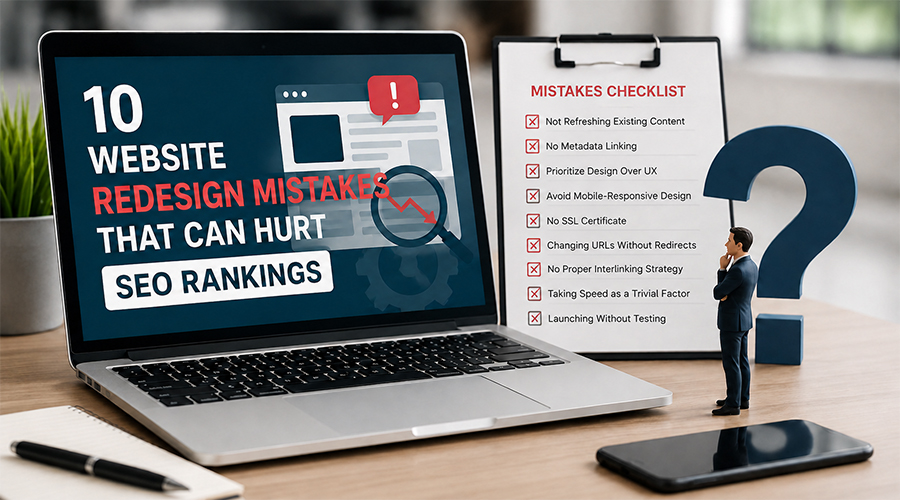
Many business owners want to redesign their website every four to five years just to get a fresh vibe, but a website’s redesign should not hinder your growth. Instead, it should bring positive results without damaging your SEO rankings or potential leads.
To be honest, it is quite difficult to cut through the noise in this highly competitive marketplace. You may notice some of your pages will disappear, URLs can change, content may lose relevance, and technical issues will appear if you don’t take advice from the best SEO consultant in India.
This blog will walk you through 10 redesign mistakes that silently kill your organic traffic and gradually erode your SEO rankings. The practical fixes are given to help your team resolve any problems before launching.
Key Takeaways:
- Think of SEO from day 1; not after the launch.
- Redirects from older pages to newer ones are non-negotiable.
- Focus on technical basics like metadata, SSL, speed, backlinks, and canonical tags, as they are highly likely to be lost after a redesign.
- Design and UX should work hand in hand and must not compete with each other.
- Nothing should go live without pre-launch overall testing.
10 Web Redesign Mistakes to Avoid Losing Rankings & Leads
- Ignore SEO from Day 1
When it comes to web design, owners mostly start with better wireframes and color palettes, leaving SEO as an afterthought. What’s the point of having an aesthetic store if no one can find it? Think of it, and then you can understand the importance of SEO and start acting on it. Reports suggest that the earlier you start, the sooner it can build momentum, as it generally takes 3-6 months to show results.
Fix:
- Hire the best SEO expert in India who is experienced enough to handle cases like website redesign issues.
- Take time to map keywords, URLs, and content structure even before design work begins.
- You can also connect with a professional SEO team and discuss your SEO requirements.
- Not Refreshing Existing Content
During a redesign, everyone focuses heavily on appearance, so the blogs or service pages that were once ranked slip in rankings. Instead of posting more and more blog posts, try revamping your existing ones with new features and perspectives. Add new ideas such as FAQs, key takeaways, or screenshot-based methodologies to signal fresh content to search engines.
Fix:
- Conduct a thorough audit before removing old blogs.
- Instead of just changing the year, remove outdated statistics and evidence.
- Add new credentials, such as an author bio and screenshots.
- No Metadata Linking
Page titles and meta descriptions help search engines to fetch the right page. So, add uniqueness to your content and include canonical tags relevant to your post. During a redesign, these elements can disappear when templates are replaced. Then it becomes difficult for search engines to find your content, and therefore rankings drop.
Fix:.
- Take time to recreate metadata for every page before launch.
- Always use canonical tags relevant to your post, and ensure nothing is duplicated or left blank.
- Prioritize Design Over UX
Most business owners run after striking visual layouts instead of focusing on functionality. Maybe your website looks fabulous, and seeing that visitors step into it. But what do you think, do they convert when they notice confusing navigation, unclear CTAs, oversized images that look different on different devices, and so on? After redesigning, a website should look fabulous while keeping its functional features intact.
Fix:
- Confusing navigation can drop conversions from 5.3% to 4.4%, proven in an experiment.
- So, before going live, make your site’s navigation smooth and test speed and readability.
- Maintain brand consistency and provide benefit-oriented CTAs.
- Avoid Mobile-Responsive Design
Statista reports that 52.27% of global website traffic comes from mobile devices. So, making a website that looks bad on mobile phones won’t pave your path to business growth. Text that is difficult to read, buttons that are hard to tap, and layouts that break on smaller screens create unnecessary friction and can affect the overall search experience.
Fix:
- Test menus, links, buttons, forms, and every single item across devices.
- Don’t just pay attention to desktop; prioritize mobile devices equally.
- Honestly, this isn’t something you need to pay extra for. It’s kind of the right SEO solution even on a tight budget.
- No SSL Certificate
Migrating a domain or launching a new design without an SSL certificate often results in security warnings and redirect issues for visitors. Search engines can flag your site as unsafe, and that can create trust issues for many people. A redesign is the perfect time to check the security of your website.
Fix:
- Secure the domain with a valid SSL certificate.
- You also need to check the HTTPS connections and update internal links before making your website live.
- Changing URLs Without Redirects
Changing page addresses may seem harmless during a redesign, but old URLs can already have backlinks, rankings, and visitors. Removing them without 301 redirects can lead users to dead pages, and your years of earned authority can vanish in an instant. The rankings that take effort to come will simply disappear within a few days of launch.
Fix:
- You need to map every old URL to its relevant new destinations.
- Implement 301 redirects before the new site goes live.
- No Proper Interlinking Strategy
If your previous interlinks are holding up well, try using that interlinking strategy for this new website too. A well-planned interlinking method always helps search engines to fetch the pages that are mostly required by the users. A new design may remove useful links and make discovery harder, so partner with a trusted website development agency that follows best practices to maintain internal links.
Fix:
- Review internal links after restructuring pages and connect important content through relevant, natural links.
- Build topical authority across pages; for example, connect pages that cover similar topics.
- Taking Speed as a Trivial Factor
You open a website, and the loading wheel constantly spins for over 3 seconds. Do you stay on that website for a few more minutes? Obviously not. You would rather jump into another website that shows almost the same services. Similarly, just for this “speed” factor, your competitor wins over you.
Fix:
- Optimize images; use lazy loading for heavier animated videos and images.
- Enable browser caching and optimize your fonts.
- Reduce HTTP requests, third-party scripts, redundant code, and characters.
- Launching Without Testing
One of the big mistakes owners mostly make is launching the website without giving a final review. Making haste to meet the deadlines will just make your process worse. It may expose visitors to broken forms, missing images, incorrect links, indexing problems, or checkout errors.
Fix:
- Before going live, run a full pre-launch audit.
- Check every link, form, redirect, metadata, and indexing to ensure everything is working properly.
- Run a Core Web Vitals performance check before making the new website public.
How the Right SEO Support Makes a Difference
A redesign involves more than changing colors, layouts, images, or menus. SEO needs to remain connected to every major decision because changes to site structure can affect how search engines crawl, index, and understand the website.
Businesses often need Digital marketing strategies that connect website improvements with search visibility, content, user experience, and lead generation rather than treating each area separately.
If your existing website already brings valuable traffic, protecting that visibility should be a priority. An experienced SEO professional can review historical performance, identify important pages, prepare redirect maps, and monitor the site after launch. Businesses can also hire the best SEO consultant in India for dedicated support throughout the redesign process.
Budget is another concern, particularly for small businesses. The goal is not to spend money on every possible SEO service. Businesses that are thinking of creating something unique and fresh can turn to custom web design services. They will help you create a website tailored to the company’s actual customers, content, navigation, and conversion requirements, rather than forcing everything into a generic template.
A Real Case History From the SEO Lead of TTC SEO India
Our SEO team lead, Mrs. Pritha Gupta, shares one of her stories that states, “A mid-size business owner once came to me after redesigning their website. The state was like he had lost all recognition, rankings, traffic, and potential leads he had earned over the years. All of it was gone overnight just because of this website redesign process. He just wanted his growth back.
Firstly, I start with SEO audits to check what the redesign had actually broken. Then start mapping the canonical tags and redirects to the new site, which immediately stopped the losses.
After that, I came back for the rebuild with new metadata, headers, page speed, and other internal linking- all aligned properly, followed by refreshed content on the pages that mattered most.
Within weeks, rankings started climbing back, and traffic and leads followed close behind. That person still says “thanks” to me whenever he gets the chance. To be honest, these small accomplishments encourage me to work harder for the businesses that need someone to fix what has directly taken their growth and revenue.
Conclusion
Business owners want a website redesign to enhance their brand image. But if the process is done by novice hands, then it can derail your path of growth.
Every mistake discussed in this blog can be easily avoided when you choose the right website development partner or an experienced digital marketing team that has sufficient knowledge of the current trends and modern SEO strategies.
You should think about SEO from the very first day you establish your website, not after launch. When the work requires specialist guidance, the best SEO consultant in India can help balance search visibility, user experience, and technical requirements. So you don’t have to worry about losing your SEO rankings or potential clients.