

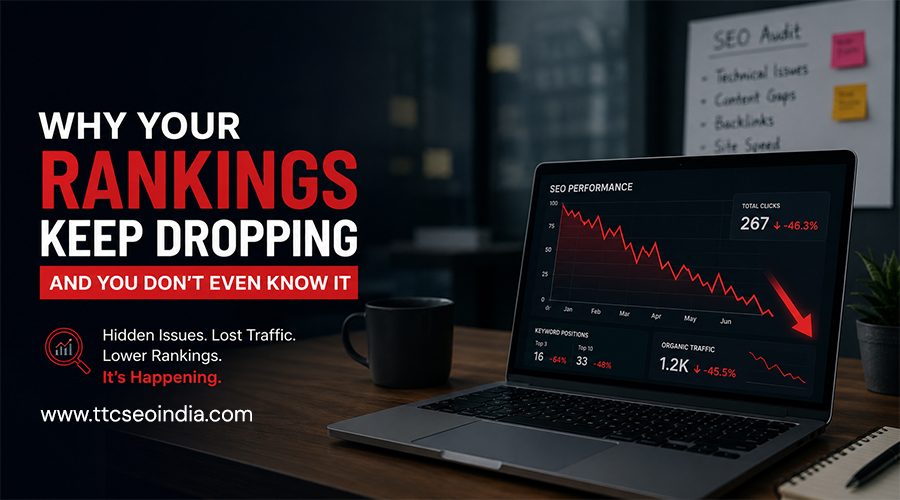
You didn’t touch a single page, didn’t change your hosting, didn’t do anything different — yet your traffic just dropped 30-60%, and nobody on your team can explain why.
This happens more often than people admit, and most site owners don’t catch it until the damage is already done. By the time you finish reading this, you’ll know exactly which of the eight common causes is hurting you and what to fix first.
Whether you run an e-commerce store, a SaaS product, or a local service business, working with a professional SEO company in India or figuring this out yourself, this breakdown applies either way.
Key Takeaways:
- Rankings rarely drop for one obvious reason — it’s usually 1 of 8 recurring, overlapping causes.
- Always confirm it’s a real drop first — compare two 28-day GSC windows before you diagnose anything.
- Flat rankings don’t mean flat traffic — SERP features like AI Overviews can quietly kill your clicks.
- No penalty notice doesn’t mean no damage — Google can demote content silently through core updates.
- The answer is almost always already in Search Console — you just have to know where to look.
Quick Reality Check: Are You Actually Dropping?
Before panicking, figure out if this is a real drop or just normal SERP noise. Pull up Google Search Console and compare two 28-day windows, then break it down by page type and query type.
Look at the shape of your ranking drop — a sudden cliff means something different than a slow, steady slide. That shape alone tells you a lot about what’s actually going on.
The 8 Hidden Reasons Your Rankings Keep Dropping
Most ranking drops aren’t random — they usually trace back to one of eight recurring causes, and once you know what to look for, spotting yours gets a lot easier. Here’s what to check first.
Google Core & Spam Updates You Didn’t Notice
Core updates can knock your rankings down even when you haven’t changed a thing on your site. If you’re a local business asking yourself why my Google business profile isn’t showing up the way it used to, an unannounced core update is often the real culprit, not anything you did wrong.
The March 2026 core update volatility block shows the real changes which help you understand where your strategies are still lacking.
Content Decay & Intent Shift
Content doesn’t just sit there staying relevant forever. It quietly goes stale as what people search for shifts underneath it. This isn’t rare either: content decay costs 68% of websites organic traffic every year, and it usually starts small, around a 10-15% dip that most site owners brush off until it snows. A professional SEO company in India would typically catch this early by comparing your worst dropping pages in GSC against what’s currently ranking for those same queries.
Technical SEO Regressions
Sometimes the problem isn’t your content at all; it’s something broken under the hood nobody noticed. According to one audit report, sites not optimized for Core Web Vitals are 48% more likely to drop in rankings after an update, and the same report found over 60% of traffic losses trace back to technical SEO or site structure issues.
Running through a proper technical SEO checklist regularly because 73% of pages with good CWV always come in top 10 placements. Core Web Vitals and indexing status in GSC, catches this before it eats weeks of traffic.
Can’t Find Your Business on Google?
Backlink Loss & Profile Quality Issues
Lose a few solid backlinks and don’t be surprised if a page quietly drops. It’s more common than people think; sites that lose high-authority backlinks can see a 20-40% decline in keyword visibility, and separately, 66.5% of links pointing to sites over the past nine years are already dead.
Check your linked pages inside GSC or run your domain through Ahrefs to see what disappeared, and watch for spammy links dragging your profile down too.
Cannibalization & Internal Competition
Two of your own pages end up fighting each other for the same keyword, and neither one wins. It’s a real fix, not just theory. This is why keyword cannibalism needs to be stopped; otherwise, your rankings will keep decreasing.
You’ll usually spot it as a jagged, sawtooth pattern in rankings, and fixing it means merging pages, cleaning up internal links, and sorting out canonical tags.
SERP Feature Changes & CTR Cannibalization
Your ranking position can stay exactly the same while your traffic quietly disappears. AI Overviews are a big reason why organic CTR sits at 2.36% on searches showing an AI Overview, compared to 3.82% where none appears, per Seer Interactive’s 2026 data.
Rank and traffic just aren’t the same thing anymore, so check impressions versus CTR in GSC — if impressions held steady but clicks dropped, this is likely why.
AI-Generated & Low-Effort Content Penalties
Mass-produced content with no real depth or first-hand experience is getting quietly demoted, no penalty notice required. This is exactly the kind of gap the best SEO expert in India would flag immediately.
They make result-driven strategies and add real data, examples, and clear author credentials to fix it.
Site Changes, Migrations, and Invisible Mistakes
A redesign or CMS migration can break canonicals, kill internal links, or strip out schema without anyone realizing it happened.
Most website redesign mistakes show up clearly once you run a crawl report and compare it against your pre-migration snapshot.
Real-World Mini Case Study
One e-commerce site lost half its traffic almost overnight after the March 2026 core update. The cause wasn’t a penalty; it was thin, repetitive product descriptions that read like they’d been churned out by AI with zero human input. Once they rewrote the pages with real detail and specifics, rankings started climbing back within weeks.
Getting Traffic But Still No Leads?
Conclusion
Most ranking drops feel mysterious right up until you actually dig into the data — then the cause is usually sitting right there in Search Console. Whether you handle this in-house or bring in a professional SEO company in India to run the diagnosis for you, the fix almost always comes down to finding the right cause on this list and addressing it directly. Want a free SEO audit checklist, or ready to book a strategy call to get this sorted?